





This work is licensed under a Creative Commons Attribution-ShareAlike 4.0 International License


Grass Fires, Bush Fires, Farm Land Fires
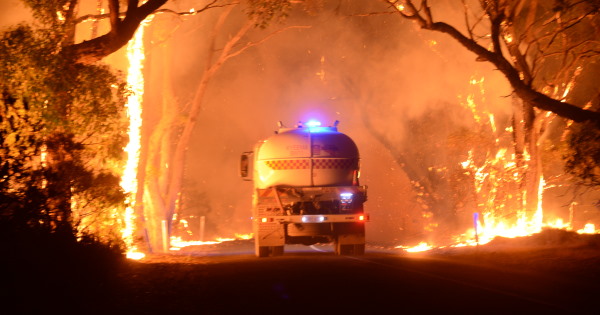
Rural fires account for around a quarter of all callouts the CFS attends, and include stubble, scrub and bushfires. These types of fires are where the heritage of the CFS lie, although in modern times, the equipment used to combat rural fires has improved from beaters and knapsacks. All CFS volunteers are trained to combat rural fires, and all appliances carry equipment to combat those fires.
Rural fires are often collectively referred to as Bushfires, which can include fire in grasslands, crops, scrub area or in forests. These fires can be very large and very mobile, with the size and magnitude dependant on terrain, fuel load and prevailing weather conditions.
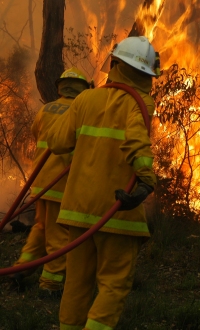
Rural fires have many different characteristics. For example, a fire in the Adelaide Hills with its highly undulating terrain, will travel differently from a rural fire on the flat Mallee plains, whilst a grass fire on the Adelaide plains, will have a different ferocity than a fire in a South East Pine Forest. In areas of the Adelaide Hills, the steep terrain and narrow access tracks means light manoeuvrable vehicles called 14 and Light Rural appliances are most suitable as they can access these difficult areas. In flat grassland areas, a larger appliance such as a 24 or 34 appliance is often more suitable than a 14, as it carries more water, and can easily access flat or sloping paddocks.
Rural fires can be knocked down, either by fire appliances, with the assistance of aerial bombers, or controlled by back burning around the fire perimeter. Back burning stops a moving fire, by creating a burnt-zone, where the vegetation was burnt in a controlled manner. As vegetation cannot burn twice, the fire cannot burn through control burn lines. The difficulty of back-burning, is that the control lines need to be wide enough to prevent the fire from 'jumping' over them, and must be burnt in a manner safe enough so that the controlled burn does not become out of control.
Direct attack of a rural fire involves CFS volunteers on appliances either confronting the fire head on or chasing the fire, working from the burnt side of the fire. The crews 'knock down' the fire with water from high-pressure hose-lines and then once contained and extinguished, mop-up the fire to prevent re-ignition.
Any major rural fire requires a significant amount of water. Fire appliance's water capacity can be anywhere from 450 litres upwards, with most now carrying 2,000 to 3,000 Litres. These appliances are supported by Tankers, which carry more than 5,000 Litres of water. They will cart from a water source to fill appliances at the fire-front. This allows the appliances to remain near the fireground, without having to travel long distances to refill.
Where the water source is a long way from the fire front, a 'staging point' is often used. Water is collected by the tanker at the source and carried to the staging point not far from the front-line firefighting effort. A portable tank, called a floating collar dam may be established for the tanker to dump its water into. A portable pump is often left with the floating collar dam to pump the water into the appliances or the appliance can draft water themselves. Fire appliances then travel the relatively short distance from the fire front to the staging point and collect their water before returning to the fire.
In rural fires, many property owners and neighbours may use their own private appliances, or water tankers mounted on tray trucks, to assist the CFS
Photographs on this page taken by the CFS Promotions Unit